
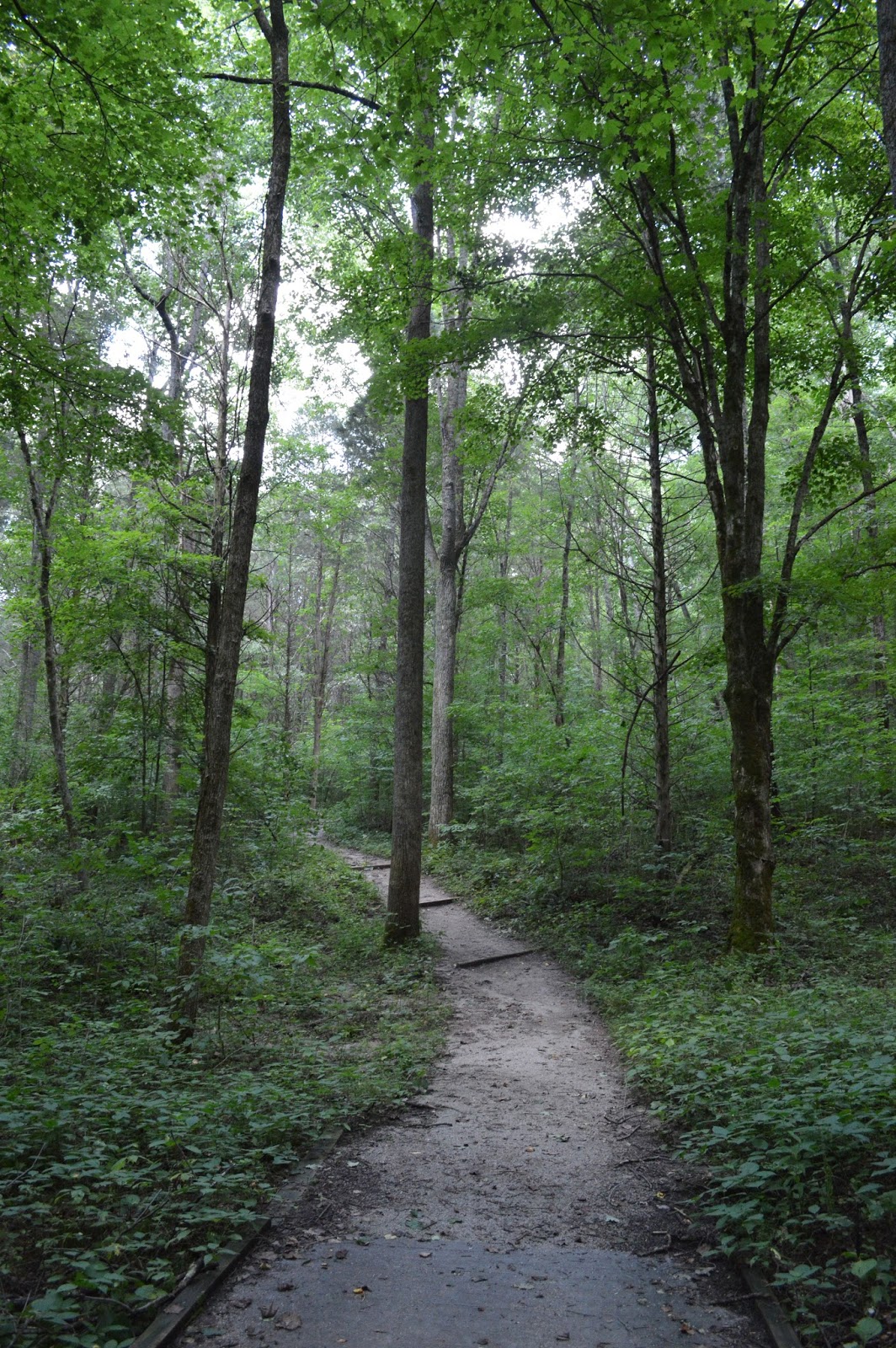
At the southernmost part of Mammoth Cave Park is this short trail, Cedar Sink, which takes you down into a very large sinkhole, and back, giving you a chance to observe many kinds of trees, wildflowers, animals, and fungi, as well as some very interesting geological features.
From Bowling Green take 31W north and turn left
onto 422. Once you get into Mammoth Cave Park,
you'll see the Cedar Sink Trailhead on the right.
The trailhead is at 37.155500, -86.160561
 |
| I like to take the loop in a clockwise direction, going down the west staircase into the sink and going out the south staircase. |
Today, I am in search of a specific wild orchid, the
Cranefly Orchid. I saw a couple of leaves in the Spring and am hoping they are flowering, now.
Cranefly Orchid. I saw a couple of leaves in the Spring and am hoping they are flowering, now.

 |
| Phlox (Click any photo to enlarge it) |
 |
| Tick Trefoil |
 |
| Agrimony |
 |
| The very distinctive leaf of Agrimony. |
Click here for information on Agrimony.
Today, July 31st, is traditionally the last day of summer. According to ancient tradition, summer ends today and autumn begins on August 1st.
One of the first things you should learn is how to identify Poison Ivy. Which of the photos below is Poison Ivy: the one on the left or
the one on the right?
(the answer is in the caption of the next photo)


 |
| There are many Cedar patches, like this one, on this trail, thus the name Cedar Sink. (the photo on the right is Poison Ivy..."leaflets three, let it be"; the left one is Virginia Creeper, which won't give you a rash.) |
Centuries ago, people used to celebrate this time of year, the mid-point between the summer solstice and the autumnal equinox. It's a cross-quarter day that goes by many names: Brón Trogain ('earth's sorrow'), Festival of First Fruits, First Harvest, Calan Awst (Welsh), and Freysblot (Norse).
 |
| A butterfly called a Question Mark. Can you see the question mark pattern (sideways) on the hindwing, below? |

 |
| Descending down to the sink area. Take your time and observe your surroundings. |
 |
| You will see Yule Ferns in every forest that you visit in KY. The ends of the fronds produce sori on the bottom of their leaflets. |
 |
| Each sorus (sporecase) is filled with spores, which will be released to begin a new generation of ferns. |
 |
| Here's the beginning of the loop trail, where you can go either left or right. You will end up back at this point, either way; I like to go left in a clockwise direction. |
 |
| A species of St. Johnswort |
 |
| Starry Campion 3/4 inch Click here for information. |
 |
| Tall Bellflower |
Tomorrow, August 1st, marks the time of year when the first grains and fruits are harvested, therefore, it is sometimes called "First Fruits."
 |
| The trail takes you to the west staircase, which takes you deep into the geologic depression called Cedar Sink, a massive sinkhole, which actually has several sinkholes within it. |
 |
| To the right of the staircase are Walking Ferns. Click here for information. |
 |
| At the bottom of the stairs take a left and walk down the short trail to this observation deck and just stop, look, and listen. |
 |
| A Tussock Moth caterpillar was strolling on the observation deck. They're harmless...pick one up. |
Click here to see how a Tussock Moth caterpillar gets around.
 |
| The floor of Cedar Sink was covered in Spiderworts. Click here for info. Tonight, and August 1st mark the time when the first grains are 'sacrificed' to ensure the continuation of the harvest cycle, therefore highlighting the link between life and death. |
 |
| Then, turn around and head back to the bottom of the staircase. |
 |
| White Avens |
Click any photo to enlarge it.
As the first grains are harvested at this time, food and drinks such as wheat, barley, corn, bread, whiskey, and beer are significant. Traditionally, bonfires were lit, with the ashes of previous bonfires scattered over the fields, in order to bless the
fields, cattle, and people.
 |
| A couple of Red Spotted Purple Butterflies sipping water from some organic waste. Click here for a video of Red Spotted Purples. |
 |
| White Tick Trefoil |
Lughnasadh can be thought of as a time of personal reflection of our actions and deeds and our gains and losses over the past year. It is a time when we start to reap what we started sowing in spring. This requires introspection and honestly as we look inside to examine our thoughts, feelings,
and decisions.
 |
| Go to the observation deck and observe the stream below. This is an exposed part of an underground stream. The running water comes out of the ground (top part of photo) and returns below the ground (bottom right). |
Most people don't realize there are many rivers underground, flowing through cave systems, such as the one in this area.

 |
| The trail is clogged with vegetation. |


 |
| This trail leads to an area where you can see the spring, the point where the stream comes out of the rocks. |
 |
| Ruellia or Wild Petunia |
 |
| The spring is to the left, hidden by vegetation. |
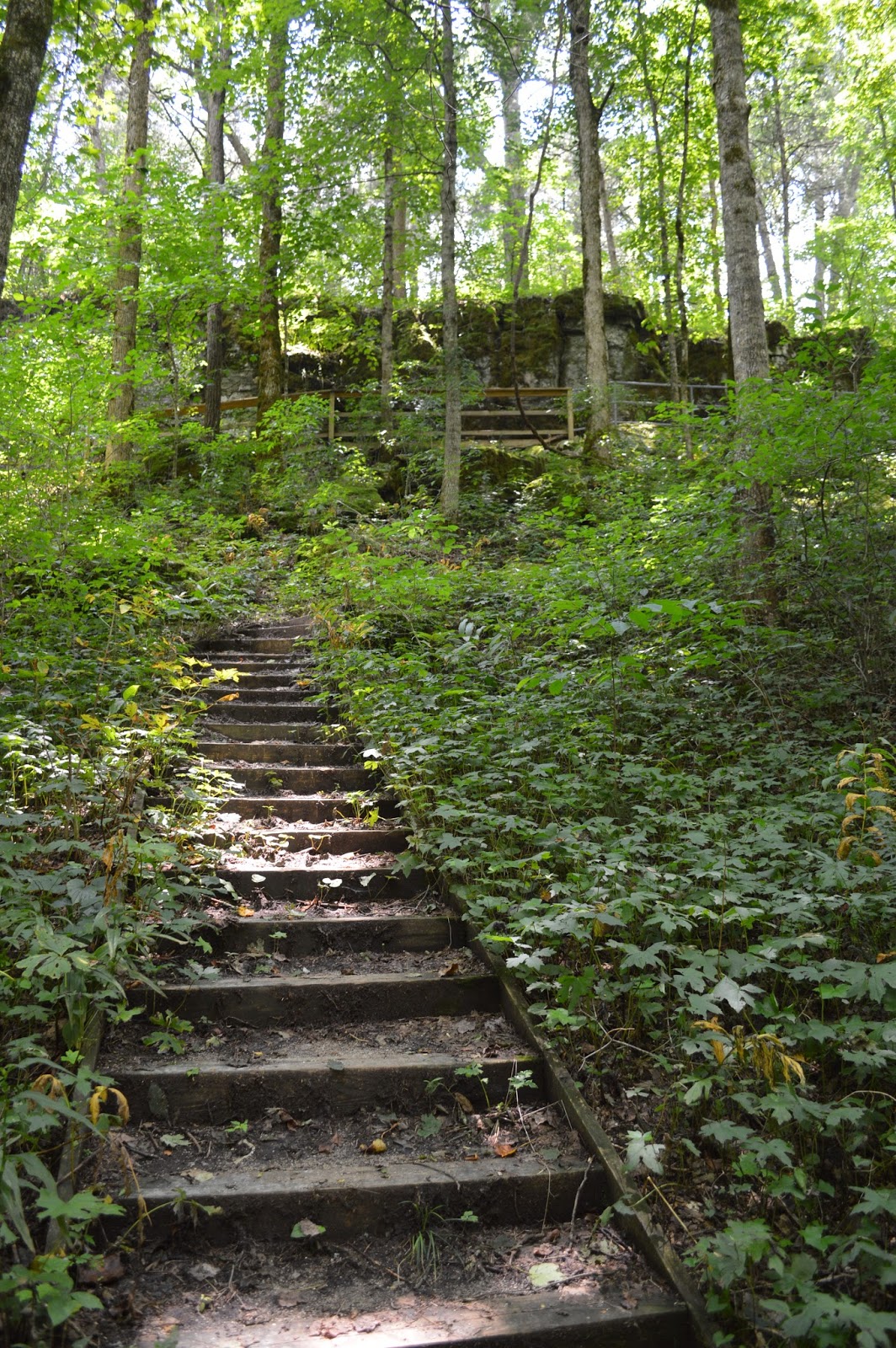
Continue on the trail and you will come to the south end of Cedar Sink. After you have observed your surroundings you can head up the stairs, the south staircase, which takes you to another
observation deck.
 |
| Turn left where the stairs split to go to the observation deck. |
 |
| Pale Indian Plantain Click here for information. |
 |
| Looks like a species of Lactarius. |
 |
| Thimbleweed with pollinator. |
 |
| From here you can see down into another sinkhole. |
 |
| A colorful Red Admiral. Click here for information. |
Video of Red Admirals!
 |
| The top of the south staircase looking down into Cedar Sink. |
 |
| Heading back to the trailhead. |
Wow! This is the flower I was looking for!
It's leaf lies on the ground through Autumn and Winter and decomposes through Spring. The flower will grow where the leaf was.
It's leaf lies on the ground through Autumn and Winter and decomposes through Spring. The flower will grow where the leaf was.
Click "here," below for information.
 |
| Cranefly Orchid!! |
Click here for information.
 |
| Close-up of Cranefly Orchid. Click here to watch a video. |
 |
| Turn left at this intersection. This is the beginning of the loop trail, where you were earlier. |
 |
| A plant called Heal All with some beautiful little flowers. Click here to watch a great video about Heal All. |
It was great to be able to see the flowers of the Cranefly Orchid,
whose leaves I saw in the Spring.
Come here any time of the year.
whose leaves I saw in the Spring.
Come here any time of the year.
It's a great place to explore!
To learn more about the ancient
To learn more about the ancient
Wheel of the Year, just go to this site.
Click the site below to go to
my Autumn blog:
To see Cedar Sink in the spring click here.
Get out and see your natural surroundings,
To see Cedar Sink in the spring click here.
Get out and see your natural surroundings,
which will help you to appreciate the beauty
of the natural world around you.
